NANJING – On the morning of March 25, 2026, the seventh academic report of the "Nanyong Earth Science Lecture," organized by the School of Earth Sciences and Engineering at Nanjing University, was successfully held in the Zhu Gongshan Building. This session specially invited Xu Changgui, Chief Scientist of China National Offshore Oil Corporation (CNOOC), Chief Geologist of the limited company, and a renowned offshore oil and gas exploration expert, to deliver a special report titled "Recent Theoretical and Technological Progress, Major Breakthroughs, and Future Prospects of Oil and Gas Exploration in China's Seas". The lecture was hosted by Dean Chen Tianyu and attended by Academician Chen Jun, other experts, and over 300 teachers and students from within and outside the university.
On behalf of the school, Chen Tianyu warmly welcomed Chief Geologist Xu Changgui and briefly introduced his academic achievements and outstanding industry contributions. Subsequently, centering on the strategic demands for national oil and gas energy, Xu systematically elaborated on the latest theoretical advancements and key technological breakthroughs in China's offshore oil and gas exploration. This included a basic overview of CNOOC's recent oil and gas exploration and development, the progress in theoretical understanding and major breakthroughs in deep-layer exploration in the Bohai Bay, the theoretical progress and major discoveries in deep-layer exploration in the South China Sea, the theoretical and technological advancements and major breakthroughs in ultra-deep water and ultra-shallow layers, as well as CNOOC's overall future development strategy and planning goals.
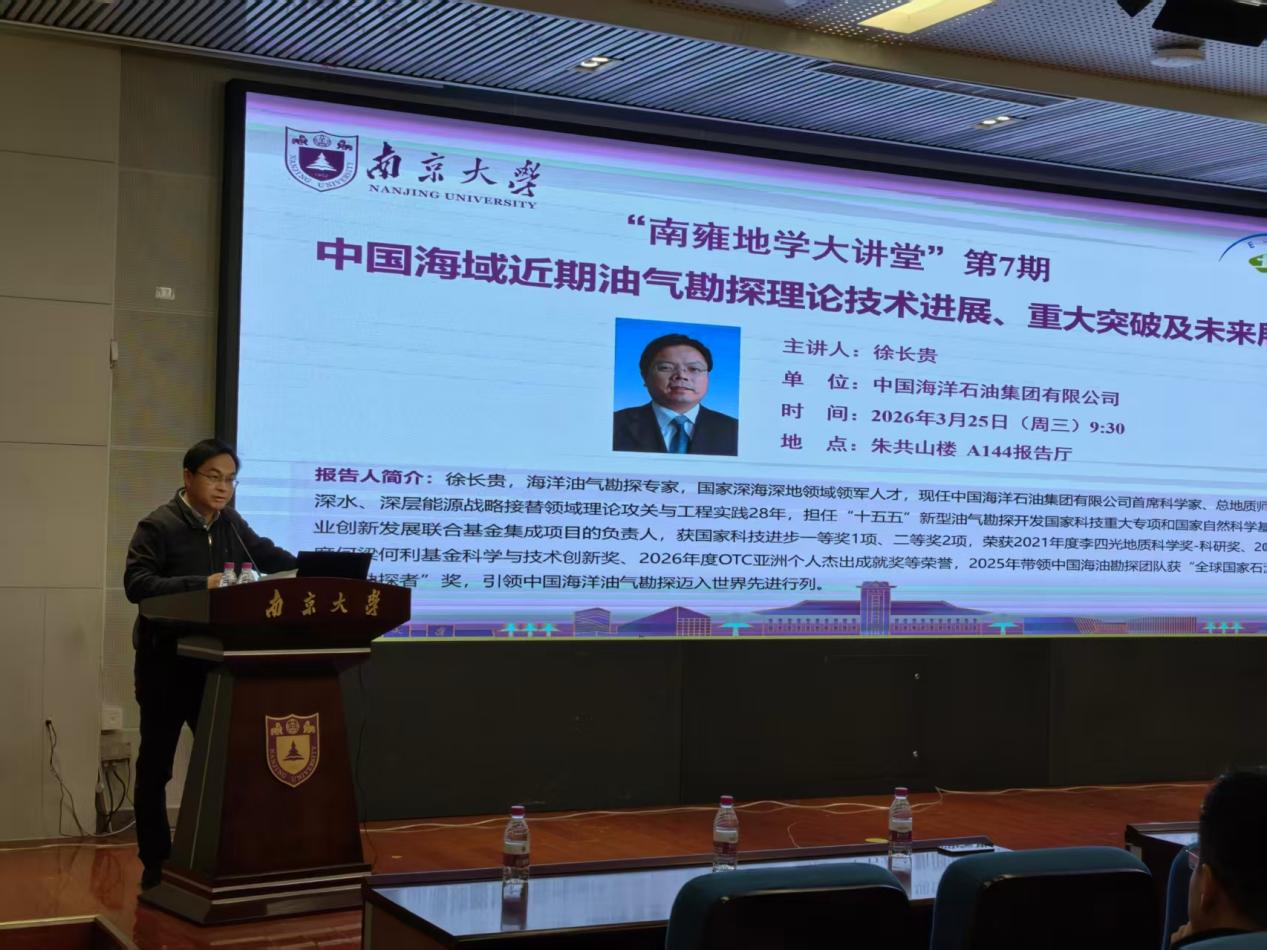
Xu Changgui shared CNOOC's explorations and reflections on offshore oil and gas exploration in recent years. Recently, oil and gas exploration in China's seas has achieved a series of major breakthroughs—from the deep layers of the Bohai Sea to the deep waters of the South China Sea, and into "unmapped territories" such as ultra-deep waters and ultra-shallow layers. Behind these breakthroughs are not only hardcore engineering technology advancements but also innovations in geological theoretical understanding. Xu systematically reviewed the scientific logic behind these major breakthroughs and offered forward-looking perspectives on the fundamental scientific issues facing future offshore oil and gas exploration.
Xu pointed out that China's demand for oil and gas resources will remain high in the future. He stated that CNOOC is building a new-era oil and gas exploration and development system with marine characteristics, focusing on five major directions: "strategic guidance, stabilizing oil and increasing gas, green integration, technology-driven, and digital-intelligent empowerment," to provide more solid support for safeguarding national energy security.
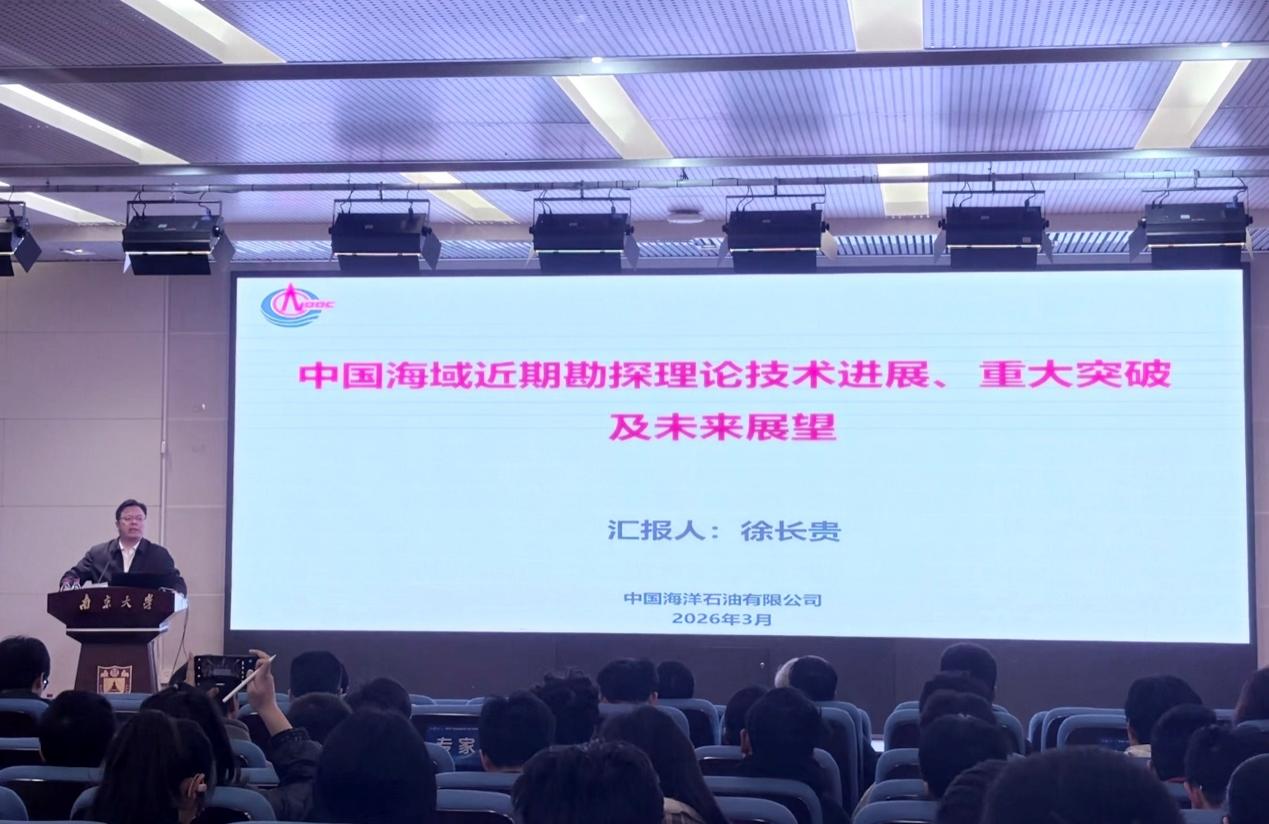
The content of this report was accessible yet profound, featuring a broad perspective that triggered enthusiastic responses from teachers and students. During the interactive session, Xu and the attendees engaged in in-depth discussions on the frontiers of exploration theory and key technological issues, further expanding academic horizons and clarifying related research directions. Chen Tianyu expressed sincere gratitude for the excellent report and encouraged the students to actively devote themselves to the national offshore oil and gas cause.
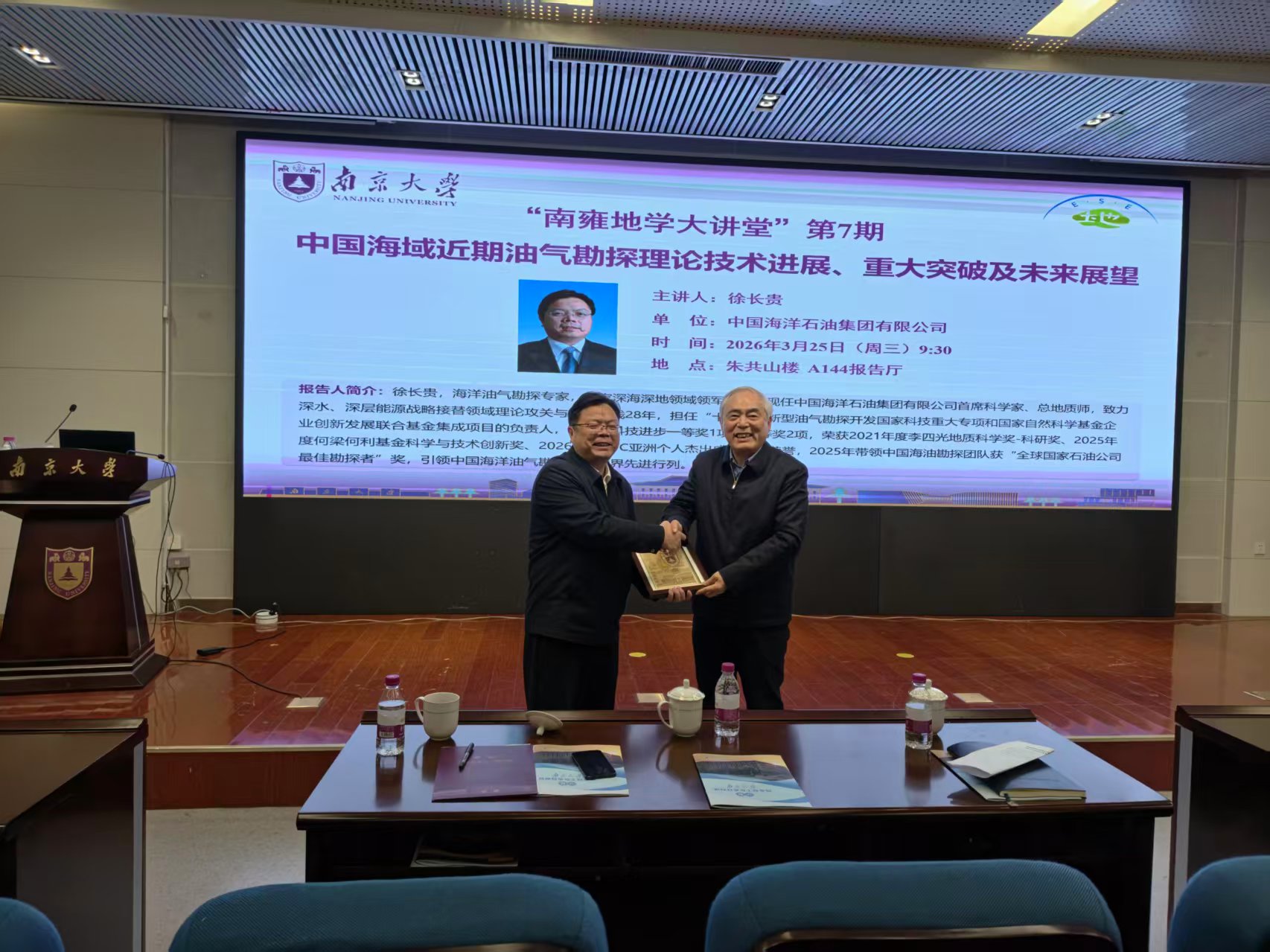
Following the lecture, Academician Chen Jun presented Xu Changgui with a Nanjing University souvenir, and student representatives presented him with flowers.
The successful hosting of this lecture is a practical implementation of Nanjing University's "Forging Ahead Action" plan. It pragmatically advances the content of the strategic cooperation agreement between Nanjing University and CNOOC, adheres to conducting organized scientific research oriented towards major national needs, and opens a brand-new chapter of in-depth cooperation between the two parties.
Photography by: Yunrui Xu
Text by: Jian Cao
Reviewed by: Ting Dong