Recently, a theoretical team led by Associate Professor Shanyu Han at the International Center for Isotope Effects Research, School of Earth Sciences and Engineering, Nanjing University, together with Professor Daiqian Xie from the School of Chemistry and Chemical Engineering at Nanjing University, collaborated with the experimental team of Academician Xueming Yang and Researcher Kaijun Yuan at the Dalian Institute of Chemical Physics, Chinese Academy of Sciences. Their joint effort has led to an important advance in molecular photochemistry: the observation of quantum interference arising during the dissociation of water molecules through a single conical intersection channel.
Quantum interference is a central principle of quantum mechanics and a key manifestation of the wave nature of microscopic particles. In 1801, the British physicist Thomas Young first observed quantum interference in the famous double-slit experiment, demonstrating the wave nature of light and marking a milestone in the history of science. In chemical reactions, atoms and molecules—also microscopic particles—may travel from reactants to products along multiple possible pathways simultaneously. The quantum wavefunctions associated with these pathways can interfere with one another, thereby enhancing or suppressing the probability of reaction.
At the beginning of the 21st century, quantum interference was first observed in the photodissociation of water at 121.6 nm, where the interference originated from two dissociation channels associated with two distinct conical intersection regions. Since then, similar interference phenomena have been gradually revealed in chemical reactions. To date, most of these effects arise from two spatially distinguishable reaction pathways, analogous to the interference pattern produced in a double-slit experiment. By contrast, another fundamental type of interference in optics—single-slit diffraction—results from the coherent superposition of multiple pathways within a single channel. Direct experimental evidence for this type of interference in chemical reactions has long been lacking.
To address this challenge, the experimental team led by Academician Xueming Yang and Researcher Kaijun Yuan at the Dalian Institute of Chemical Physics employed a narrow-linewidth extreme-ultraviolet (EUV) light source to excite the water isotopologue HOD to highly excited electronic states. Using high-resolution detection techniques, they measured the quantum-state distribution of the products and discovered that the rovibrational state distribution of the OD fragment varies significantly with excitation wavelength.
On the theoretical side, the team of Associate Professor Shanyu Han and Professor Daiqian Xie constructed high-accuracy coupled multi-electronic-state potential energy surfaces for water using neural networks. Their calculations revealed that the observed phenomenon originates from quantum interference between direct and indirect dissociation pathways occurring within a single conical intersection region. Although these two pathways are spatially indistinguishable, they differ in the time taken by the molecular wavepacket to traverse them. Their physical essence is therefore highly analogous to single-slit diffraction in optics.
By combining high-resolution experiments with high-accuracy theoretical calculations, this work demonstrates the first example of quantum interference in molecular photodissociation through a single conical-intersection reaction channel. The results deepen our understanding of the fundamental nature of nonadiabatic chemical reactions associated with conical intersections on potential energy surfaces. The findings not only contribute to the development of more precise theoretical descriptions of chemical reactions, but also lay the groundwork for future quantum-level control of chemical processes. In addition, the work provides a foundation for elucidating the mechanism of hydrogen–deuterium isotopic fractionation under extreme-ultraviolet vacuum conditions.
The results were published on March 3, 2026, in Nature Chemistry under the title “Quantum interference between direct and indirect reaction paths in the photodissociation of HOD.” The first authors are Junyan Wang, a PhD student from the School of Chemistry and Chemical Engineering at Nanjing University, and Zijie Luo, a joint PhD student trained at the Dalian Institute of Chemical Physics. Associate Professor Shanyu Han, Professor Daiqian Xie, and Professor Kaijun Yuan are the corresponding authors.
This research was supported by the Strategic Priority Research Program of the Chinese Academy of Sciences (“Precise Detection of Chemical Reaction Transition States Based on an Extreme-Ultraviolet Light Source”), the National Natural Science Foundation of China, and the Science and Technology Innovation 2030 Major Program of the Ministry of Science and Technology.
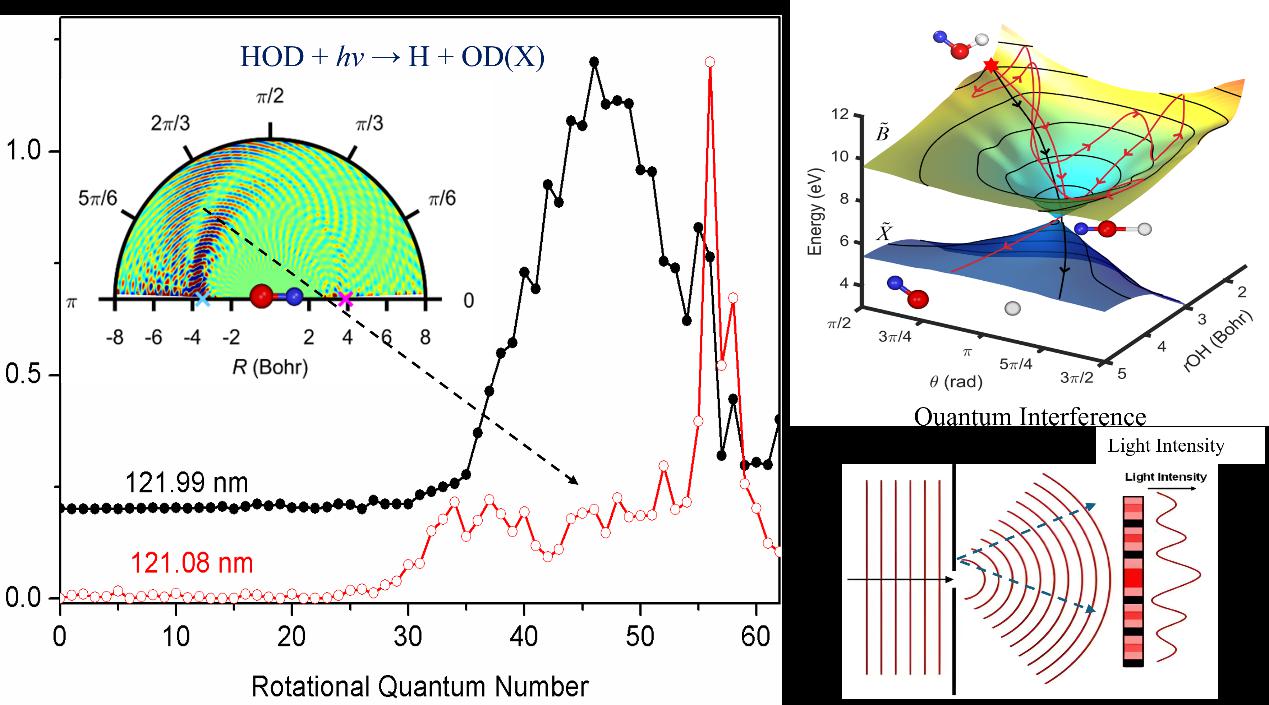
Figure caption:
Quantum interference arising from the direct and indirect dissociation pathways of water through a single conical intersection region leads to a pronounced excitation-wavelength dependence of the rotational state distribution of the OD fragment, analogous to single-slit diffraction in optics.
Original link:https://www.nature.com/articles/s41557-026-02078-w