Jan. 14, 2026 — A landmark study led by Prof. Xiumian Hu team in Nanjing University has overturned a long-standing geological model for the eastern Tibetan Plateau. The 500-kilometer-long Yidun belt (Figures 1, 2), a classic textbook example of an ancient island arc, is now shown to have formed during continental collision—not from oceanic plate subduction.
Published in the journal Terra Nova, the findings challenge a cornerstone theory used to reconstruct the ancient Paleo-Tethys Ocean. This shift in interpretation has direct implications for understanding the region's formation and for guiding future mineral exploration strategies.
A Contradiction in the Rock
For decades, the Yidun belt’s chemical signature—enriched in certain elements and depleted in others—perfectly matched the expected “fingerprint” of magmas formed above a subducting oceanic plate. This led to its firm designation as the “Yidun Island Arc”.
However, Professor Xiumian Hu’s international team uncovered a fundamental field contradiction. In the Zhongza Terrane, they found that the granitic rocks, presumed to be part of the arc, intrude into and thermally alter older deep-sea turbiditic rocks (Figure 3).
“This is a clear timing sequence,” explained Hu. “The sediments were deposited first, then the magma cut through them. In a true, active island arc system, the volcanic arc and the adjacent deep-sea sedimentary basin develop simultaneously. What we see here tells a different story.”
Sediments Point North, Not Local
The team’s investigation into the ancient turbiditic sediments provided a second critical line of evidence. If the Yidun magmatic rocks had been a towering volcanic arc, the surrounding seafloor sediments should be filled with its erosional debris.
Through detailed analysis of sand composition and detrital zircon ages, the researchers traced the sediment source. They found that the deep-water deposits in the study area were identical to those in the vast adjacent Songpan-Ganzi Basin, and both were sourced from ancient mountain belts far to the north (Figure 4).
“The sediments carried a clear passport showing an origin in the Qilian–East Kunlun-Qinling belts, hundreds of kilometers away to the north” said Hu. “There is no signature of a local, eroding volcanic arc. This means the area was a unified, deep marine basin receiving distant sediment before the magmatic event.”
Collision, Not Subduction
Despite its “arc-like” chemistry, the magma’s isotopic makeup told the final piece of the story. The isotopic signatures indicated the magma was formed primarily from the melting of pre-existing ancient continental crust, not from a mantle wedge fertilized by a subducting slab.
The researchers propose a new model: during the Late Triassic collision between continental blocks, deep-seated tectonic forces caused mantle upwelling. This heat triggered the large-scale melting of the older continental crust, generating magmas that, during their formation, acquired chemical traits easily mistaken for those of a subduction zone.
Implications for Science and Exploration
This reclassification from an “island arc” to a “syn-collisional magmatic belt” has significant ripple effects:
Tectonic Models: It provides a crucial new constraint for accurately piecing together the closure timeline of the Paleo-Tethys Ocean and the growth of the Tibetan Plateau (Figure 5).
Exploration Guidance: Major mineral deposits in the region, like the prolific Pulang copper district, may need to be re-evaluated. Their formation would be linked to continental collision processes, which can generate different mineralization styles and distributions than subduction arcs.
Global Example: The study serves as a cautionary tale and a methodological guide for geologists worldwide, demonstrating that “arc-like” geochemistry alone is not definitive proof of subduction and must be weighed against structural and sedimentary evidence.
“Our work underscores that in geology, the rocks themselves—their relationships and their history—are the ultimate arbiters of truth”.
Reference: Hu, X., Wen, D., Pan, Y., Garzanti, E., Deng, T., Dong, X., Ma, A., Zhao, Z. (2026). Syn-Collisional Origin of Yidun Arc-Like Magmas and Northern Provenance of Songpan-Ganzi Turbidites (Eastern Tibet). Terra Nova. DOI: 10.1111/ter.70025
Funding: This research was supported by the National Deep Earth Exploration and Mineral Resources Project and the National Natural Science Foundation of China.
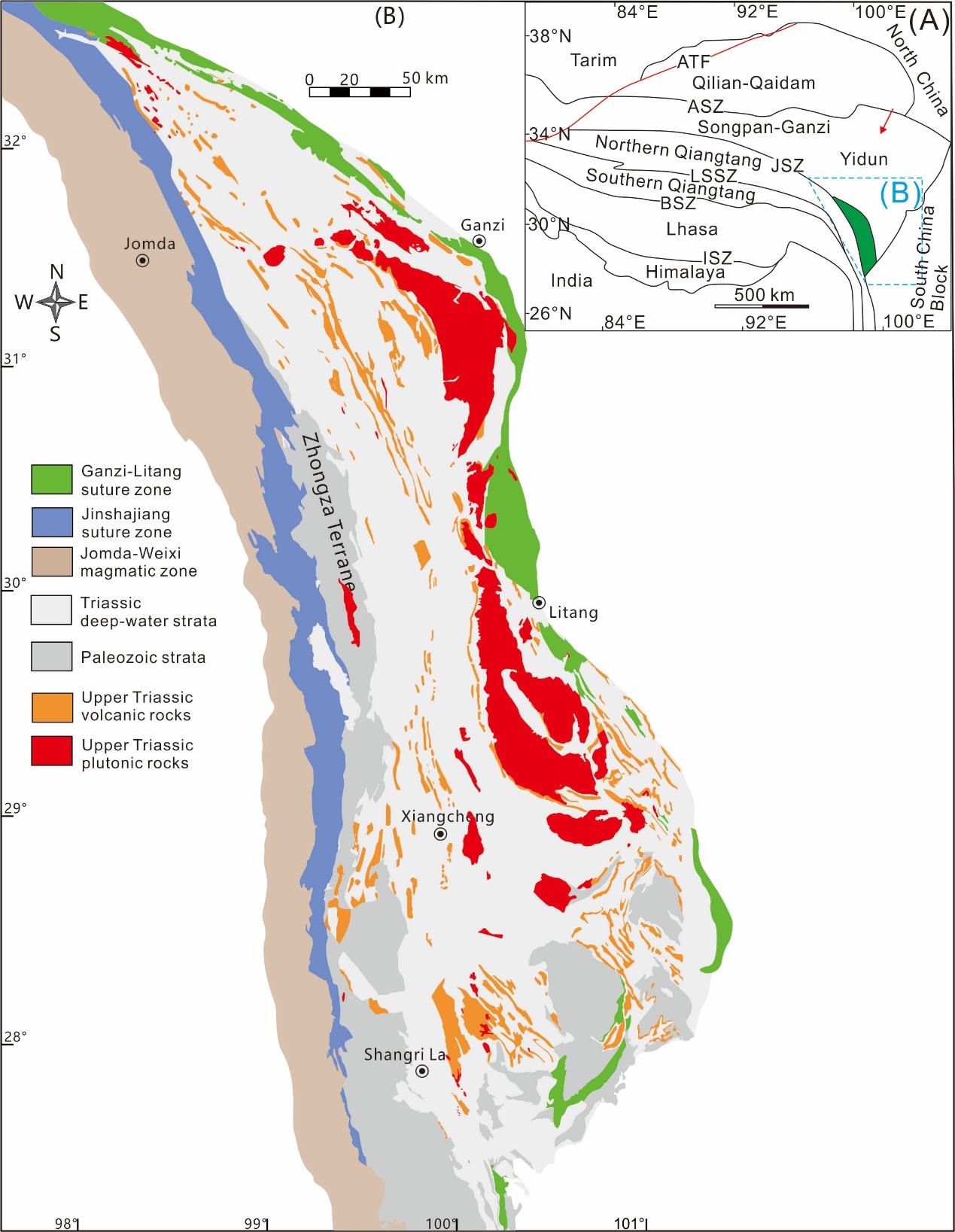
Figure 1. Geological sketch map of the Ganzi-Litang area in the eastern Tibetan Plateau, with the Yidun magmatic rocks highlighted in red.
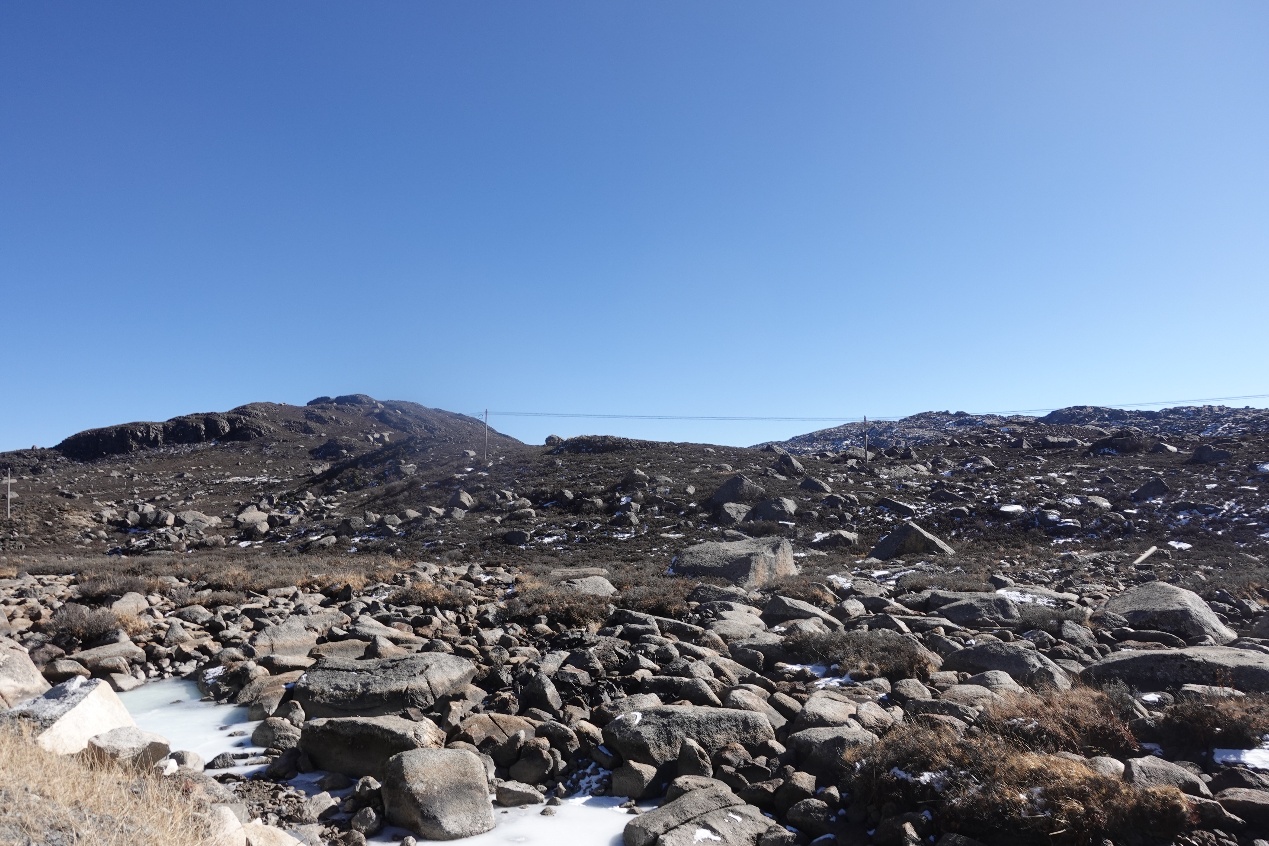
Figure 2. Typical granite landforms in the study area (Daocheng-Yading region), with the plutons serving as the key research targets of this study.
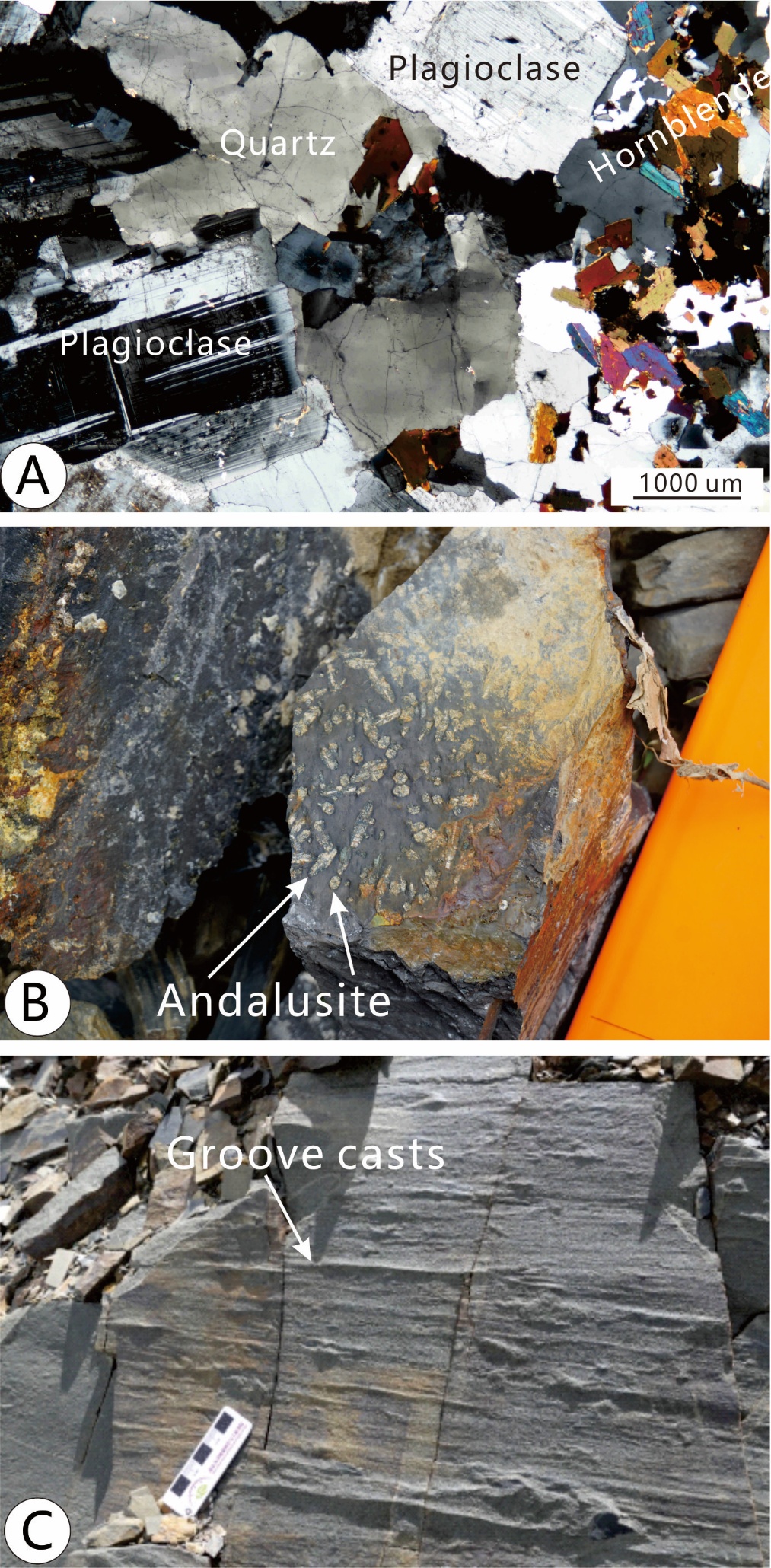
Figure 3. (A) Typical photomicrographs of the Yidun magmatic rocks; (B)Andalusite hornfels formed by intrusive contact between granite and Triassic strata; (C) Sole structures of Triassic turbidites.
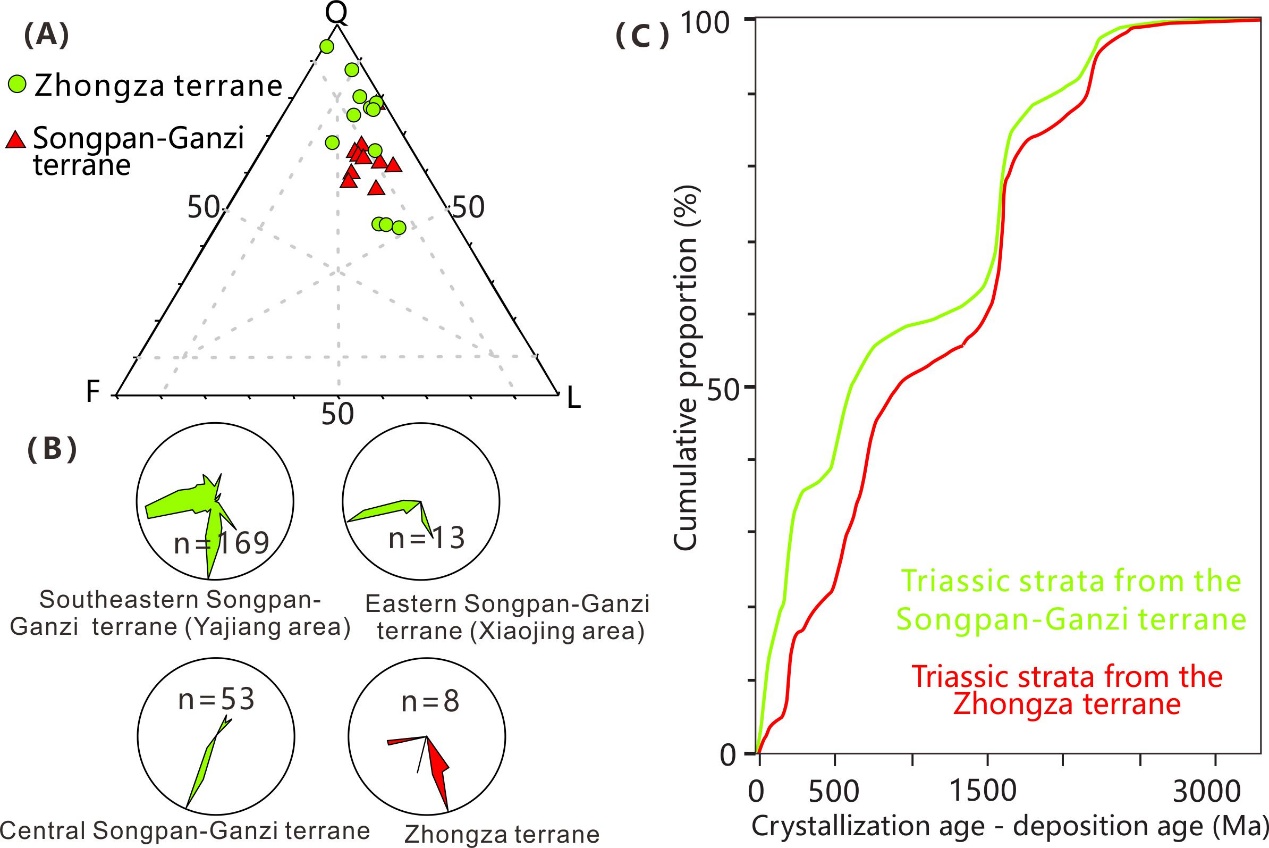
Figure 4. A comparison of Triassic turbidites between the Zhongza and Songpan-Ganzi terranes: QFL (quartz-feldspar-lithic) triangular diagram (A); paleocurrent directions (B); cumulative probability curves of detrital zircon ages (C).
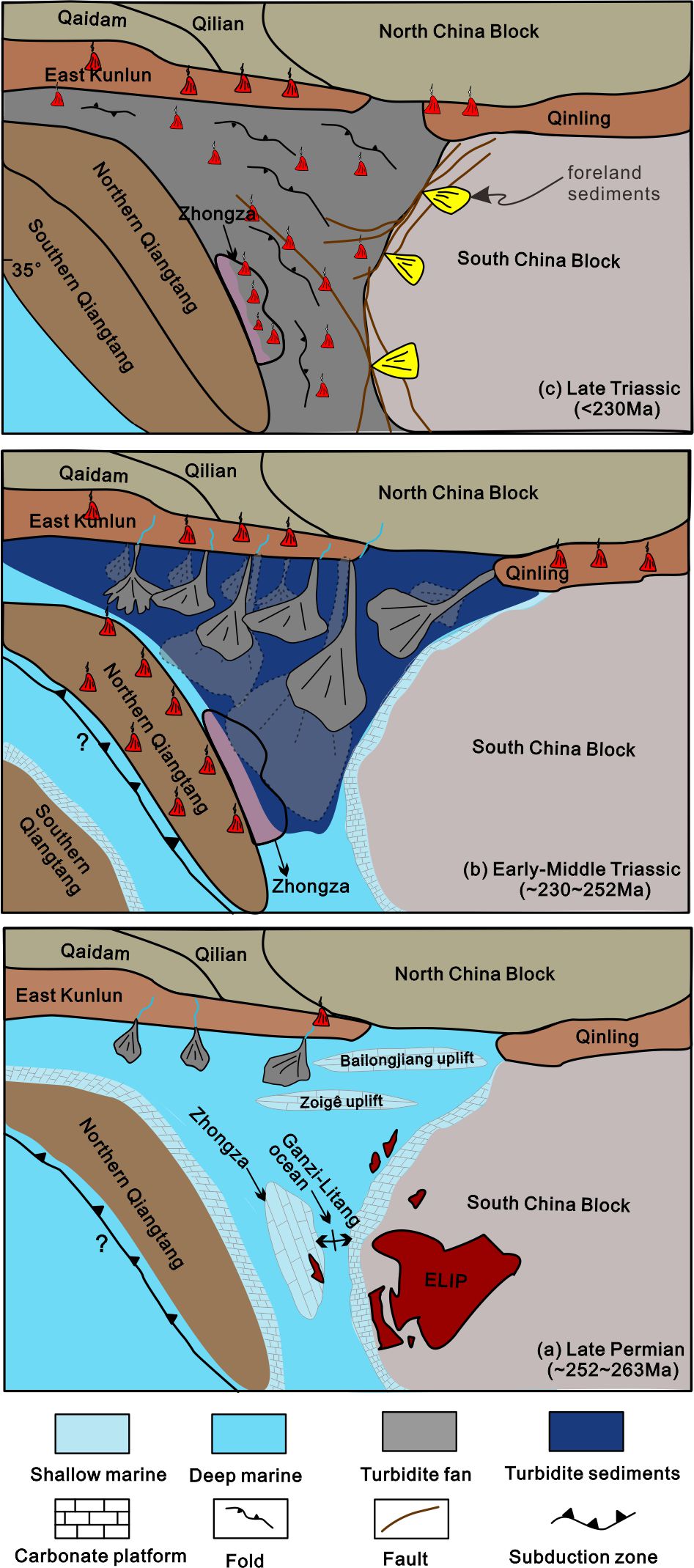
Figure 5. A sedimentological-tectonic evolutionary model constructed based on the study of the Zhongza terrane.