To deeply implement General Secretary Xi Jinping's series of important discourses on education, science, technology, and talent, as well as the spirit of his important reply to young scholars returning from overseas at our university; to deepen the implementation of the spirit of the National Education Conference; and to actively carry out Nanjing University's "Striving Action" (Fenjin Action) plan for the innovation and quality improvement of graduate education, the School aims to continuously explore new pathways for cultivating internationalized graduate talent and vigorously promote the development of high-level innovative talents who possess both a global vision and a deep love for their country.
On the afternoon of December 29, 2025, the School of Earth Sciences and Engineering hosted the "Merging Global Perspectives, Forging New Research Frontiers" Graduate International Academic Exchange Event. Held in the AD26 Lecture Hall of the Zhu Gongshan Building, the event featured special guests Anatoly Belonoshko and Shohei Hattori. Attendees included Wang Xiaolin (Vice Dean), Yao Jing (Deputy Party Secretary), Zhao Dandan (Doctoral Counselor), Cui Yanan (Graduate Academic Secretary), along with Master's and PhD students. The event was hosted by Li Yutong, a 2025 Master's student.
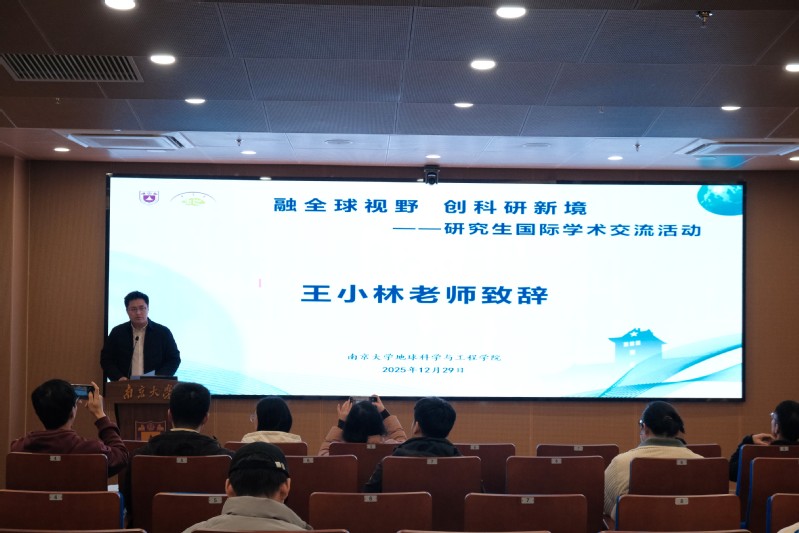
At the beginning of the event, Vice Dean Wang Xiaolin delivered the opening address. Professor Wang encouraged graduate students to set aside their anxieties and boldly showcase their progress; to listen and observe more, and actively engage in cross-disciplinary exchange; to take a long-term view and benchmark against international frontiers; and to root themselves in needs and serve national development. He noted that while the road of academic research is long and arduous, one is never lonely with companions. He expressed hope that this academic exchange would serve as an opportunity for students to illuminate and inspire one another, using enthusiastic discussion and deep critical thinking to bring a successful close to this year's research journey and build energy for the year ahead.
▼Professor Wang Xiaolin delivering the opening address
The event consisted of two parts: Invited Guest Reports and Academic Research Sharing. The two international faculty members, Anatoly Belonoshko and Shohei Hattori, first shared their insights with the students.
Invited Guest Reports
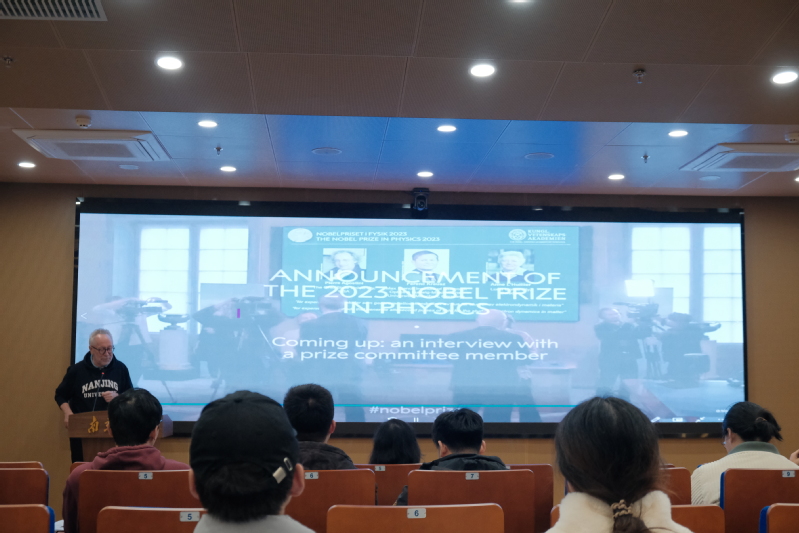
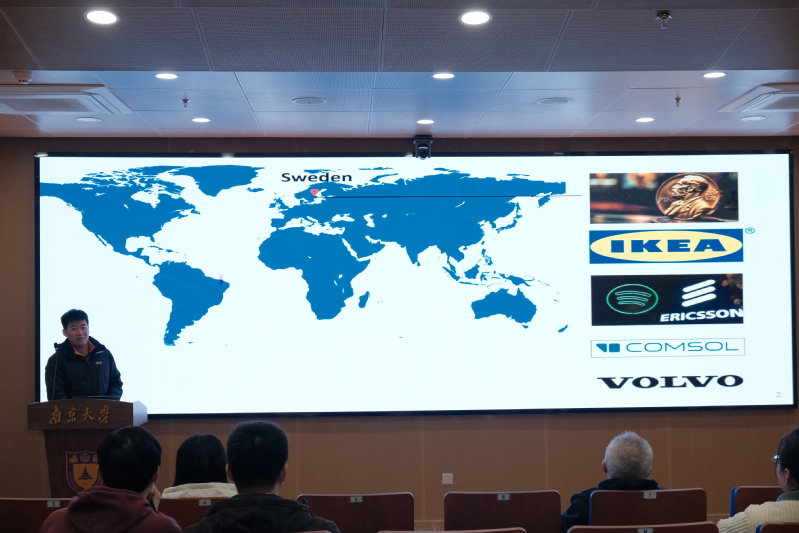
Drawing on his extensive international work experience, Professor Anatoly Belonoshko introduced the details of the Nobel Prize announcement, the award ceremony, and the banquet procedure. He emphasized that the honor of the prize far outweighs its monetary value. Additionally, he shared photos depicting the work and daily life of a former colleague—a secretary of Nobel Committee in Physics—to highlight that even Laureates are ordinary people in their private lives. He concluded by encouraging the students to strive for their dreams while they are still young.
▼Professor Anatoly Belonoshko sharing
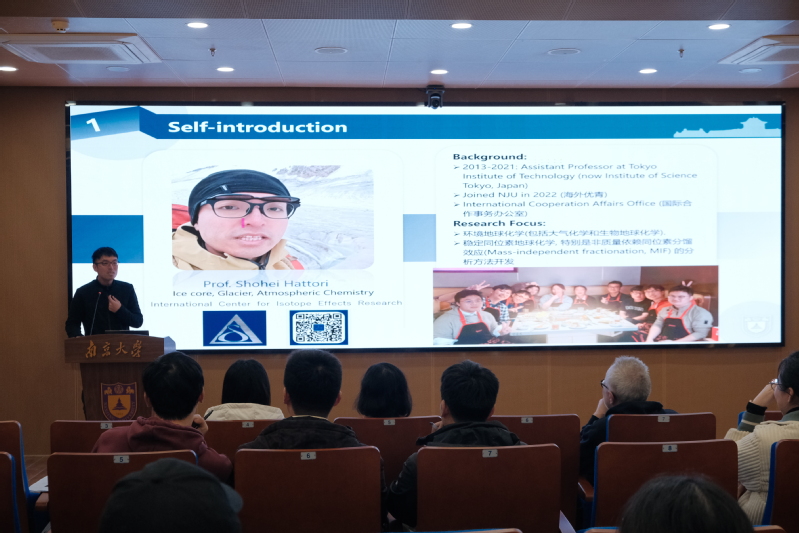
Associate Professor Shohei Hattori gave a sincere presentation combining his rich academic and work experiences spanning Japan, Europe, and China. He encouraged students to communicate proactively and actively build interpersonal connections, describing this as key to overcoming cultural barriers and gaining a fulfilling experience. Addressing the common concern of choosing schools for study abroad, he suggested focusing on the compatibility of the supervisor, the team, and the environment. He expressed that the research level of China's top universities is already at the global forefront, so studying abroad should focus more on broadening one's international horizon. Furthermore, he introduced the informal exchange activities such as "Coffee Time" regularly organized by the School's International Cooperation Affairs Office, which aim to build a relaxed platform for intellectual collision and cross-cultural friendship among faculty and students. Finally, he encouraged the students: "Don't wait for the perfect moment; set out bravely and grow through interaction and practice."
▼Associate Professor Shohei Hattori sharing
Following the wonderful introductions by the two international teachers, Zhang Ruijie (Geology), Zhang Junzheng (Geological Resources and Geological Engineering), and Xing Kun (Hydrology and Water Resources) shared insights combining their research directions with their overseas study experiences.
Academic Research Sharing
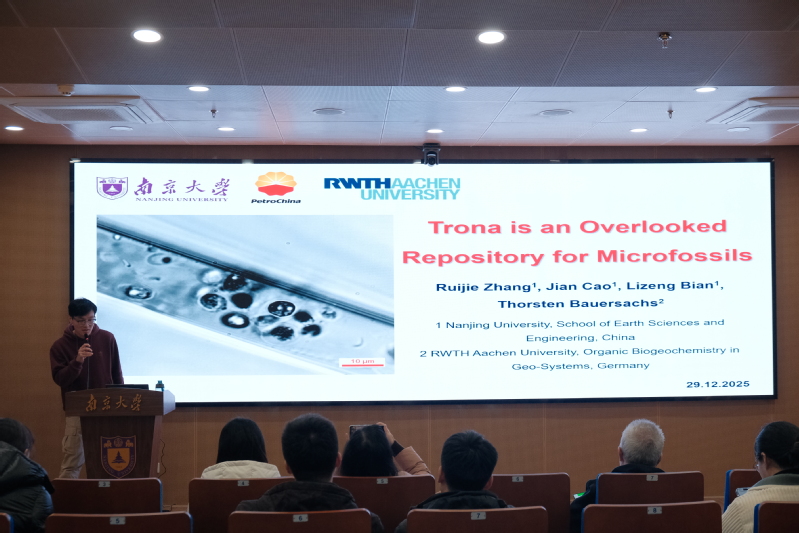
Dr. Zhang Ruijie (Geology) shared his study abroad experience and research results at RWTH Aachen University in Germany, under the title "Extreme Microorganisms Preserved in Ancient Soda Lake Trona Inclusions: Implications for the Origin of Life and Extraterrestrial Life Exploration." During his joint training, he collaborated with Professor Thorsten's team to deeply analyze microfossils and biomarkers in trona. The study found that trona inclusions preserved life forms similar to modern Dunaliella and other extreme microorganisms capable of surviving in high-salt, high-pH environments. Fluid inclusions not only recorded the morphological characteristics of these microorganisms but also retained important chemical information revealing their adaptation mechanisms. In his report, Zhang Ruijie pointed out that the microbial chemical library in trona fluid inclusions provides a brand-new perspective for astrobiology and origin of life studies. These findings not only offer key clues for exploring extreme life on Earth but may also become ideal targets for searching for extraterrestrial life, especially in extreme alkaline environments on planets like Mars.
▼Zhang Ruijie sharing
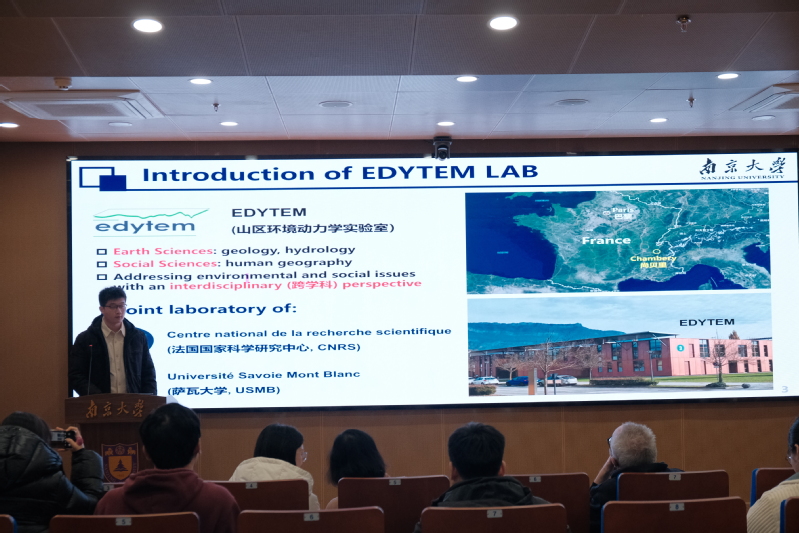
Dr. Zhang Junzheng (Geological Resources and Geological Engineering) reported on his research experience at the CNRS EDYTEM laboratory in France, titled "Multi-scale Application of Induced Polarization." He first introduced the host institution and the foreign team, explaining that when applying for CSC projects, one should consider both their own research and the academic influence of the foreign supervisor. Subsequently, using the electrical conduction and polarization characteristics of the electrical double layer outside mineral particles as an entry point, he introduced the core research result of the foreign team—the "Dynamic Stern Polarization Model"—and explained the causes and characteristics of the induced polarization phenomenon. Based on theoretical study, he participated in large-scale field surveys with the team, completing geophysical detection of seawater intrusion at the Pilat Dune in Bordeaux, western France; he also independently conducted small-scale laboratory research, verifying the sensitivity of the induced polarization method to the calcium carbonate precipitation process. Zhang Junzheng encouraged everyone to explore courageously and communicate actively during state-sponsored study abroad, bringing back more scientific knowledge, technical methods, and work experience to contribute to the development of scientific research.
▼Zhang Junzheng sharing
Dr. Xing Kun (Hydrology and Water Resources) shared his research progress on pollution mechanisms in fractured aquifers under the theme "Formation Mechanism of Residual DNAPL in Fractured Media." Starting from the widespread distribution of bedrock fracture water and the issue of DNAPL leakage pollution, the report pointed out that residual DNAPL, due to its low water solubility and resistance to degradation, tends to remain underground for a long time and continuously release pollutants. Deeply understanding its source zone structure and formation mechanism is key to accurately predicting pollution migration processes and formulating remediation strategies. Addressing issues such as the strong heterogeneity of fractured media and the complexity of the DNAPL residual process, the research team relied on a self-developed visualization microfluidic experimental system for fractured media to systematically carry out research on the entire water-DNAPL displacement and residual process. Results showed that under the coupling effects of capillary force, viscous force, and fracture aperture heterogeneity, residual DNAPL in fractures can form three typical source zone structures: pool mode, ganglion mode, and mixed mode, with their evolution controlled jointly by flow velocity and fracture structural characteristics. The research results provided important experimental basis for characterizing the DNAPL source zone structure in fractured media and subsequent dissolution modeling. Finally, he shared his study and life experiences during his time abroad, encouraging students to seize opportunities and broaden their horizons.
▼Xing Kun sharing
Empowered by Exchange: Clarifying Research Challenges, Inspiring Innovation
The School attaches great importance to the cultivation of graduate students' innovative abilities. It regards graduate international academic exchange as an important lever for enhancing the ability to lead in frontier areas and expanding academic horizons. Through high-level academic exchange and the collision of ideas, the School aims to stimulate students' innovative thinking and enterprising spirit, encouraging everyone to move forward steadily in academic exploration, draw wisdom from exchange and sharing, and continuously climb the peaks of academia through determined effort.